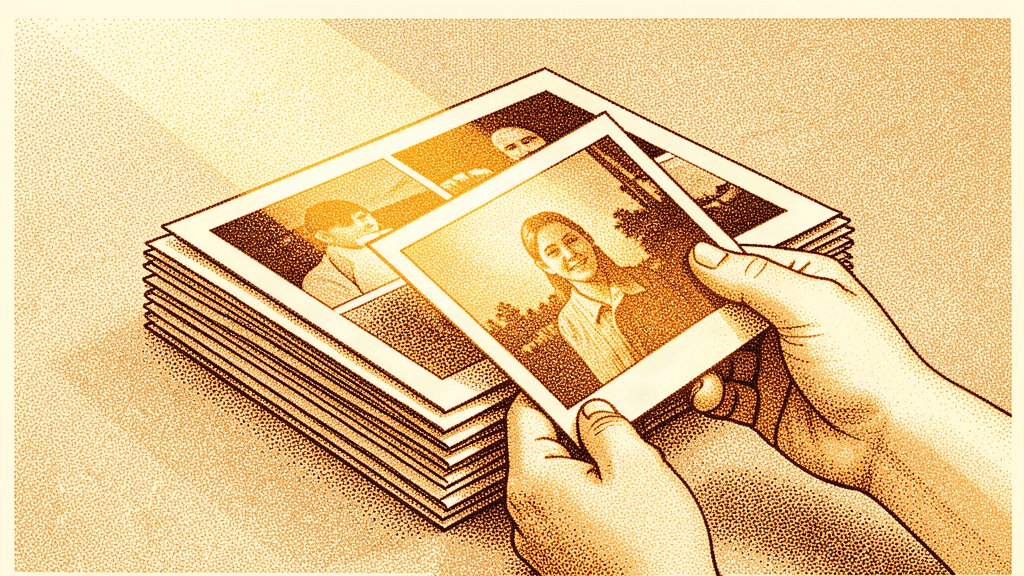
The Invisible Graveyard in Your Pocket
I want you to try something. Open your phone right now and scroll back to the photos you took six months ago. Not the ones you posted somewhere — the ones you took and meant to do something with. The ones from your toddler's birthday party. The ones from the family session we did together last spring. The ones where your daughter is making that face she only makes when she's genuinely laughing.
When did you last look at them? When did anyone else in your family see them?
Here's what I've learned after years of handing beautiful galleries to families in Spring Lake and Fort Liberty: roughly eight out of ten clients never print a single image. They download the gallery. They text a few favorites to Grandma. They set one as their phone wallpaper for a week. And then the images slide into the same black hole as every other photo they've ever taken — buried in a camera roll with 14,000 other images, never to be seen again.
I don't say this to guilt anyone. I say it because I've done the exact same thing. After my own family sessions, I've let images sit on a hard drive for years before printing them. But here's the thing: a photo that only lives on a screen isn't really part of your life. It's potential, not presence. And potential has a way of disappearing.
What Actually Happens to Digital Files Over Time
We treat digital photos like they're permanent, but they're not. They're more fragile than the faded prints in your grandmother's shoebox — and I mean that literally.
The Phone-Upgrade Wipeout
Every two or three years, most of us get a new phone. We go through the transfer process, click through some screens, and assume everything made it. But I can't tell you how many clients have told me some version of this story: 'I went to find our newborn photos to show my now-five-year-old, and they're gone. They must not have transferred when I upgraded.'
It happens with laptops, too. Hard drives fail. Devices get lost, stolen, or dropped in the toilet by a curious toddler. Ask me how I know about that last one. Digital files require active maintenance. You have to back them up, migrate them, and remember where you put them. That's work. And life is busy enough without another maintenance task on your list.
Cloud Services Aren't Forever Either
I know what you're thinking: everything's in the cloud. Google Photos, iCloud, Dropbox — that's got to be safe, right? Maybe. But cloud services change their terms, raise their prices, and occasionally shut down entirely. I've watched clients lose access to galleries because they switched email providers and couldn't recover a password. I've seen photo-sharing platforms disappear overnight, taking years of family memories with them.
And honestly? Even when cloud storage works perfectly, the photos still just sit there. They're safe in a technical sense, but they're not alive. They're not part of your home. Your kids don't stumble across them while walking down the hallway. Your spouse doesn't glance at them during a morning coffee and remember exactly what that season felt like.
Why Printed Photos Hit Different
There's something that happens when you hold a photograph in your hands that doesn't happen when you scroll past it on a screen. I've watched it dozens of times at client deliveries — a mom opens a box of prints, and within thirty seconds she's crying. Not because the images are technically perfect, but because she's holding her baby at three weeks old again. She's back in that moment in a way a screen never delivered.
The Science of Tangible Memories
This isn't just sentimental — there's research behind it. Studies on memory and physical media consistently find that printed photographs trigger stronger emotional recall than digital images. When you hold a print, your brain processes it differently. You slow down. You look longer. You notice details — the way your son's hand was curled around your finger, the exact shade of the wildflowers behind your daughter, the look your husband is giving you from across the frame that you were too distracted to notice at the time.
Prints also become part of your children's childhood in a way screens don't. Kids see framed photos on the wall every single day. They absorb them. They ask questions about them. 'Was that when I was a baby? What was I doing? Why is Daddy laughing?' Those conversations don't happen when the photos are locked in a phone that only you can access.
What's Worth Printing — And What Can Stay Digital
Not every photo needs to be printed. The blurry shot of your kid mid-sneeze, the screenshot of a recipe you'll never make, the forty-seven nearly identical photos of a sunset — those can live in the cloud indefinitely and nobody will miss them. But the images that matter? The ones where everyone is genuinely present, where the light was perfect, where your family looks like itself instead of a posed approximation? Those deserve to exist in the physical world.
Start With Your Wall
If the idea of printing everything feels overwhelming, start with one thing: a single large piece of wall art from your favorite image. Not a gallery wall of twelve frames — just one. Put it somewhere you'll see it every day. The hallway you walk through thirty times. The spot above the couch. The wall you face when you're feeding the baby at 2 a.m.
I've had clients tell me that one framed print changed how they felt about their whole home. Suddenly the house felt like theirs — like their family's story was written into the walls instead of just unfolding in them. One client, a military spouse stationed at Fort Liberty, told me she hangs the same family portrait in every new house they move into. 'It's the first thing I put up,' she said. 'Before we even unpack the kitchen boxes. It makes any house feel like we belong there.'
The Album That Gets Pulled Off the Shelf
After wall art, an heirloom album is the next thing I recommend. Not a Shutterfly book you'll toss in a closet — a real, archival-quality album with thick pages and a linen cover, the kind your grandkids will hold one day. Albums tell a story in sequence. They have weight. They sit on coffee tables and get pulled down during holidays. Your five-year-old will flip through them on a rainy Saturday and narrate her own babyhood back to you — inaccurately, adorably, and with complete confidence.
I've watched toddlers carry their family albums around like security blankets. They point at themselves as newborns and say 'baby.' They find the photo of Dad in uniform and press their finger to it. They're building their own understanding of where they come from, one page at a time. That doesn't happen on an iPad.
How I Help Families Get Images Into Their Lives
This is the part of my job that doesn't get talked about enough. Yes, I take the photos. Yes, I edit them until the skin tones are perfect and the light looks like honey. But I also help families actually do something with those images. Every gallery I deliver comes with guidance on what sizes work best for different spaces, which images pair well together on a wall, and what kind of paper and finish will hold up for decades.
I offer professional printing through a lab that produces work so far beyond what you'd get at a drugstore that I can't even compare them. The color accuracy, the paper quality, the way a fine-art print catches light — it's a completely different object. Drugstore prints fade within a few years. Archival prints last generations.
For families who want an album but don't want to design one themselves, I handle that too. You tell me which images you love, and I lay out a sequence that tells the story of your session from beginning to end. It shows up at your door ready to display — no design decisions, no formatting headaches, no abandoned half-finished project sitting in an online cart for six months.
The Math That Changed How I Think About This
Here's a number that stopped me in my tracks when I first calculated it. A professional family session produces maybe forty to sixty final images. If you print even a quarter of those — say fifteen prints — and frame five of them, you've just transformed your session from a digital file transfer into something your kids will grow up seeing every single day.
Now multiply that by the number of days your child will live in your home. Fifteen years, maybe eighteen. That's over five thousand mornings your daughter will walk past a framed photo of her family laughing together when she was four. Over five thousand times your son will see an image of himself cradled in your arms as a newborn and feel, without anyone having to tell him, that he was wanted and cherished from the very beginning.
Compare that to a gallery link that gets opened twice — once when you receive it, and once a year later when you're trying to remember which folder you saved it to.
The session fee is the cost of creating the images. The prints are the cost of giving them a life. And between those two investments, the prints might actually be the more important one. Because images that nobody sees, in a format nobody touches, in a location nobody visits — those images might as well not exist.
If you have a gallery sitting in your inbox right now — from a session we did together, from another photographer, from your own phone — this is your sign. Print one thing this week. Frame one thing. Put it somewhere you'll see it. Your future self, and your kids, will be glad you did.