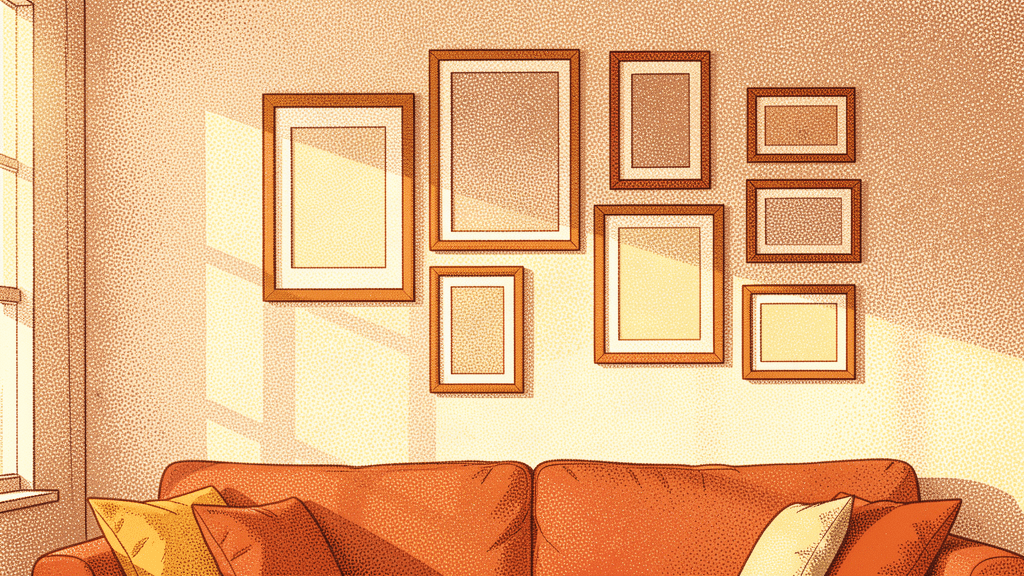
The Wall Nobody Builds
I have a theory, and I've tested it on enough families to trust it. Ask a parent how many photos of their children are on their phone, and they'll say thousands. Ask how many are framed in the house, and there's usually a pause.
Two. Maybe three. A canvas from a session three years ago, hung a little too high because nobody wanted to climb the ladder twice.
I don't say this to scold anyone. I am the same person who has a phone full of images and one embarrassing gap of empty wall above my own sofa. The printing step isn't the part anyone is bad at — it's the part nobody is taught. You learn how to take photos. You learn how to book a session. Nobody ever sits you down and explains how to get a photo off a screen and into your house.
So let's do it now, in the order the decisions actually get made. Which images to choose, which sizes work in a real room, where things belong, and the last step everyone dreads: hanging the thing.
Choosing the Images Before You Choose the Sizes
The instinct is to scroll the gallery, pick a size, and order. It's the wrong order, and it's the reason so many prints sit unappealingly on a shelf for two years. Choose the images first, then let the images suggest the format. A wide landscape shot is begging to be big. A close-up of tiny fingers is wasted at twenty by thirty.
Pick for Feeling, Not for Technical Perfection
When a family looks through their gallery with me, they always do the same thing at first: they judge faces. Is anyone blinking? Is the hair where it should be? It's a natural instinct and a terrible way to choose pictures for a wall.
Light and sharpness and expression matter, but what keeps an image on a wall for ten years is what it makes you feel the moment you walk past it. That frame of your daughter mid-laugh with her dress caught in the wind, mouth open and eyes half shut, is going to make you stop every single time. The technically pristine one where everyone is smiling directly at the camera will get a nod, maybe a compliment, and then nothing. Choose the one that makes you catch your breath.
If you're having trouble deciding, I've written before about how the photos you think you want rarely match the ones you love, and the same holds an order of magnitude more strongly for printing. The images that live on a wall are almost never the ones where people are looking at the camera.
Choose One Anchor, Then Build Around It
Before you order anything, find the hero. One image that says your family, this year, exactly as you are. It should be the one you'd grab if the house were on fire — or at least the one you keep coming back to. If you're choosing from a milestone gallery, my guide to what a milestone session actually produces breaks down which stages tend to give you the strongest frame. Everything else you hang is in service of that image.
Heroes are usually full family portraits, but not always. I've seen the anchor be a photograph of a father holding a newborn against a window, and I've seen it be a mid-run capture of three kids in the surf. The test is simple: does it tell a complete little story on its own? If yes, that's your anchor.
Matching Print Formats to Real Rooms
Sizing is where most people lose their nerve, and it's usually because of a single mistake: choosing a print that looks good on a screen instead of one that looks good from across a room.
Here's the practical shortcut I give clients. The bigger the viewing distance, the bigger the art should be. Over a sofa, you're ten to twelve feet away — that wall wants a print that's at least thirty inches in one dimension, and preferably larger. In a hallway, you're two feet from the frame as you walk past, so an eight-by-ten or an eleven-by-fourteen is plenty.
Put an eight-by-ten over a large sofa and it will read as a postage stamp, no matter how beautiful. Put a forty-inch canvas in a narrow hallway and you'll feel like you're walking into a window. When families tell me their gallery wall "never felt right," nine times out of ten the prints were simply too small for the space.
Canvas, Framed Print, or Album?
This is less about taste than about which one you'll actually use.
Canvas is the easiest large format. Frameless, light, forgiving of a less-than-perfect wall, and it works in busy rooms where a glass frame might catch a glare from the TV or a window. It suits big, open-feeling images: fields, sky, a family on a beach.
Framed prints let you control the mood of a room. A thin black frame is quiet and let the photo do the work. A warm wood frame makes a nursery feel soft. If you're doing more than one, uniform frames are almost always the better call — the eye should read the photographs, not the fifteen different frame styles competing around them.
Albums are the quiet workhorses, and they are the answer for families who genuinely cannot commit to a wall. The Museum of Modern Art's collection of photographic albums is a good reminder that a bound set of images has always been treated as an object worth keeping, not just a delivery format. An album holds forty images instead of four. It's the format that gets pulled down off the shelf and looked at, that the kids flip through, that turns a session into a story instead of a scattered set of favorites. If a gallery wall feels like pressure, an album is the honest choice, and it's the one I find families revisit more than anything hung in a frame.
This gets forgotten constantly. Not every photo needs a frame. A stack of four-by-six prints in a bowl on the coffee table does more for a child's sense of their own history than most wall art. So do the small ones pinned to a corkboard in a bedroom, the photos on the fridge, the taped-up gallery in a dorm room.
Children who grow up seeing themselves in the physical world develop a simple, quiet sense that they belong to something. The American Academy of Pediatrics talks about family routines and shared history as a core part of a child's security, and prints are one of the least expensive ways to make that history visible. You don't need a frame for that. You need a printer, some paper, and fifteen minutes.
Where the Photos Should Go
Here's the part that surprises families most: the best place to hang a photo is rarely the biggest, most formal wall in the house.
The Sofa Wall, Done Right
The classic gallery wall lives over the sofa because it's the easiest place to look at art. Two rules make it work. First, the bottom edge of the frame should hang six to eight inches above the back of the sofa. Higher than that, the art floats away from the furniture and the room feels unmoored. Second, the grouping as a whole should span roughly two-thirds the width of the sofa — not the exact width, not a small cluster in the middle, but a wide, settled block.
For a three-piece arrangement over a sofa, one large anchor print flanked by two smaller verticals is nearly foolproof. If you'd rather hang a single hero, it should be big enough to hold the wall on its own — think thirty by forty or larger.
The Hallway, the Stairs, and the Rooms You Actually Walk Through
Some of the most-loved photographs in a house live in the places everyone passes without thinking: the hallway to the bedrooms, the wall alongside the stairs, the short stretch between the kitchen and the back door. If the frames in those spots come from different seasons, keeping the clothing palette consistent across years makes a row of sessions read as one story instead of five separate ones.
Hallways reward sequences. Four or five frames in a row, same size, same frame, showing a child at four months, eight months, one year, two years. It's a timeline you walk past every morning, and it does something no single image can. On a staircase, the frames climb with the stairs — a diagonal line, evenly spaced, going up.
Not every image should be shared with the mail carrier. The quiet ones — a sleepy newborn, a nursing photo, a mother and daughter in the soft morning light of a bedroom — belong in bedrooms. So do the photographs that would feel a touch too intimate for a hallway: the ones your kids will one day be glad exist, even if they roll their eyes at them now.
And don't forget the rooms with doors. A small framed print on the shelf beside a child's bed, a photo tucked into the mirror, a canvas above a dresser. These are the ones kids see last thing at night and first thing in the morning.
The Practical Business of Hanging
Let's get past the fear. Nobody hangs things well on the first try, and everyone overestimates how annoying it will be.
Test Before You Drill
Before a single hole gets made, cut paper to the exact size of the frames and tape it to the wall. Live with it for a day or two. Move it. Slide it left. You will change your mind at least once, and paper is a lot cheaper than patching drywall. This step alone saves most families from the crooked-cluster regret that makes them stop hanging anything at all.
Once you're settled, mark the hanger position on the paper itself, drill through the mark, and pull the paper down. No measuring tape gymnastics, no second-guessing.
Three, in order of frequency. Hanging too high — the center of the art should be at eye level, roughly sixty inches from the floor, not floating near the ceiling. Spacing frames too far apart — four to six inches apart reads as one group, twelve inches apart reads as clutter. And hanging everything in one room and nothing anywhere else, which turns the gallery wall into a museum and leaves the rest of the house bare.
If you're ordering prints from your gallery and want help with the arrangement, this is genuinely part of what I do. I keep full family sessions open through the print stage for exactly this reason: it's much easier to plan a wall around real images than to guess.
Getting From Screen to Wall
One last thing, and it's the piece that stalls more families than any other. The photos are in the cloud. The session was two years ago. The order never got placed.
Please put a date on it. Pick one evening this month, open the gallery, and order three prints. Not a full gallery wall, not the leather album, not the perfect arrangement. Three prints. An eight-by-ten for the hallway and two fives for the fridge. Then, when those are up and you've lived with them for a week, order the big one.
Because the truth is that a photograph on a screen is a file, and a photograph on a wall is a memory your family gets to live beside. If your images are still sitting in a folder somewhere, my piece on getting photos out of the camera roll is the place to start. And if you don't yet have this year's photographs, we can fix that first — let's get a session on the calendar, and I'll help you take it all the way to the wall.