Why a Homecoming Needs Its Own Kind of Photographer
There's a moment in every homecoming that no amount of planning can manufacture. It's not the hug — or not only the hug. It's the half-second right before, when a child spots their parent across the tarmac or through the terminal glass and their whole body goes still, deciding whether this is really happening. That's the photograph I live for. And it's the reason I'll happily shuffle an entire week of sessions the moment a family tells me a return date has finally landed.
I remember one homecoming at Pope a few years back. A little girl, maybe four, had been waiting in a gymnasium with a sign she'd made herself — the letters running downhill, the word DADDY spelled with two D's and a backwards Y. When the doors opened and the formation filed in, she didn't run at first. She just stood there, gripping the sign with both hands, studying the row of identical uniforms like she was trying to pick her person out of a lineup. And then she saw him, and the sign hit the floor, and she was gone. That photograph — the one where she's mid-stride, mouth open, arms out — is one of the best images I've ever made. Nobody posed it. Nobody could have.
I've lived in this Spring Lake and Fort Liberty community long enough to know that homecomings are their own season. They don't show up on the mini session calendar. They don't care about golden hour or whether the weather cooperates. A plane lands at 2:40 in the morning sometimes. A formation releases early. A convoy rolls in forty minutes behind schedule. If you've ever tried to predict one, you know the only reliable thing about a homecoming is that it happens on its own schedule — and then it's over before you've caught your breath.
That unpredictability is exactly why a homecoming deserves a photographer who understands it. Not just someone with a camera, but someone who has stood in the hangar enough times to know where the light will fall, how to stay out of the way, and when to put the camera down entirely. This post is everything I want military families to know before they ask me to photograph the day someone comes home — a day the USO has been helping service members and families celebrate for generations.
The Two Kinds of Homecoming
No two reunions look alike, but most fall into one of two shapes. Knowing which one you're having changes how I shoot it.
The Ceremonial Homecoming
This is the big one. The gymnasium with the welcome banners, the bleachers full of families, the formation in uniform, and the moment everyone is released to run. It's loud and joyful and a little chaotic. There are dozens of reunions happening at once, and the energy in the room is electric — kids bouncing on their toes, spouses craning their necks, little American flags getting waved so hard they threaten to become projectiles. I shoot these wide and tight at the same time: wide enough to show the scale of the room and the sea of families, tight enough that your child's face is the whole story.
The Quiet Homecoming
Then there's the other kind. No ceremony, no crowd. Maybe it's a redeployment that came in on a private flight, or a single soldier whose unit returned weeks ago and whose family is greeting them at the front door of a house in Spring Lake. These are my favorites, honestly. They're intimate in a way a gymnasium full of people can't be. The rules are different here — I hang back, shoot through doorways and windows, and let the reunion breathe. Less direction, more documentary. If the ceremonial homecoming is a fireworks show, the quiet one is a candle. Both are beautiful. They just ask for different light.
What Happens Before I Ever Arrive
Homecoming photography doesn't start at the hangar. It starts with a handful of messages between us, usually in a hurry, because return dates shift and families are spinning with excitement and nerves.
First, we talk logistics. Where and when, to the best of anyone's knowledge. What the access situation is — because getting onto a military installation as a photographer isn't automatic, and I need lead time to arrange the proper access or decide whether you'd rather I meet you off post at the house instead. This is the single most important practical detail, and it's why reaching out as early as you can matters. The more runway I have, the more likely we can get me exactly where I need to be.
Then we talk about the moment itself. Who's coming home — a parent, a sibling? Is this a first meeting, like a parent holding a baby born during the deployment, or a reunion with kids who've done this before? Each answer changes where I stand and what I'm watching for. A first meeting gets shot close and quiet, all hands and faces. A reunion with a teenager who's been holding it together for nine months gets shot a little wider, because the way they finally let go is the whole picture.
And yes, we talk about the elephant in the room: what if the return date changes at the last minute? It will, probably. Return dates are really return windows. I hold flexible space around your expected date, and when the real one lands, we adjust. I've moved sessions the same day more times than I can count, and I've never once been annoyed about it. That's just what homecomings are.
How the Day Actually Unfolds
Every homecoming has a rhythm, and I've learned to read it. Here's what it tends to look like.
The Waiting
Waiting is its own kind of content. Kids holding signs they made with misspelled words and too much glitter. A spouse smoothing their outfit for the fourth time. The little ones who've been told for a week that Daddy's coming home today, but who won't quite believe it until they see him. I'm shooting through all of this, quietly, because these are the images that make the reunion itself feel earned. The waiting is the inhale. The reunion is the exhale. You can't tell the story with only one of them.
The First Glance
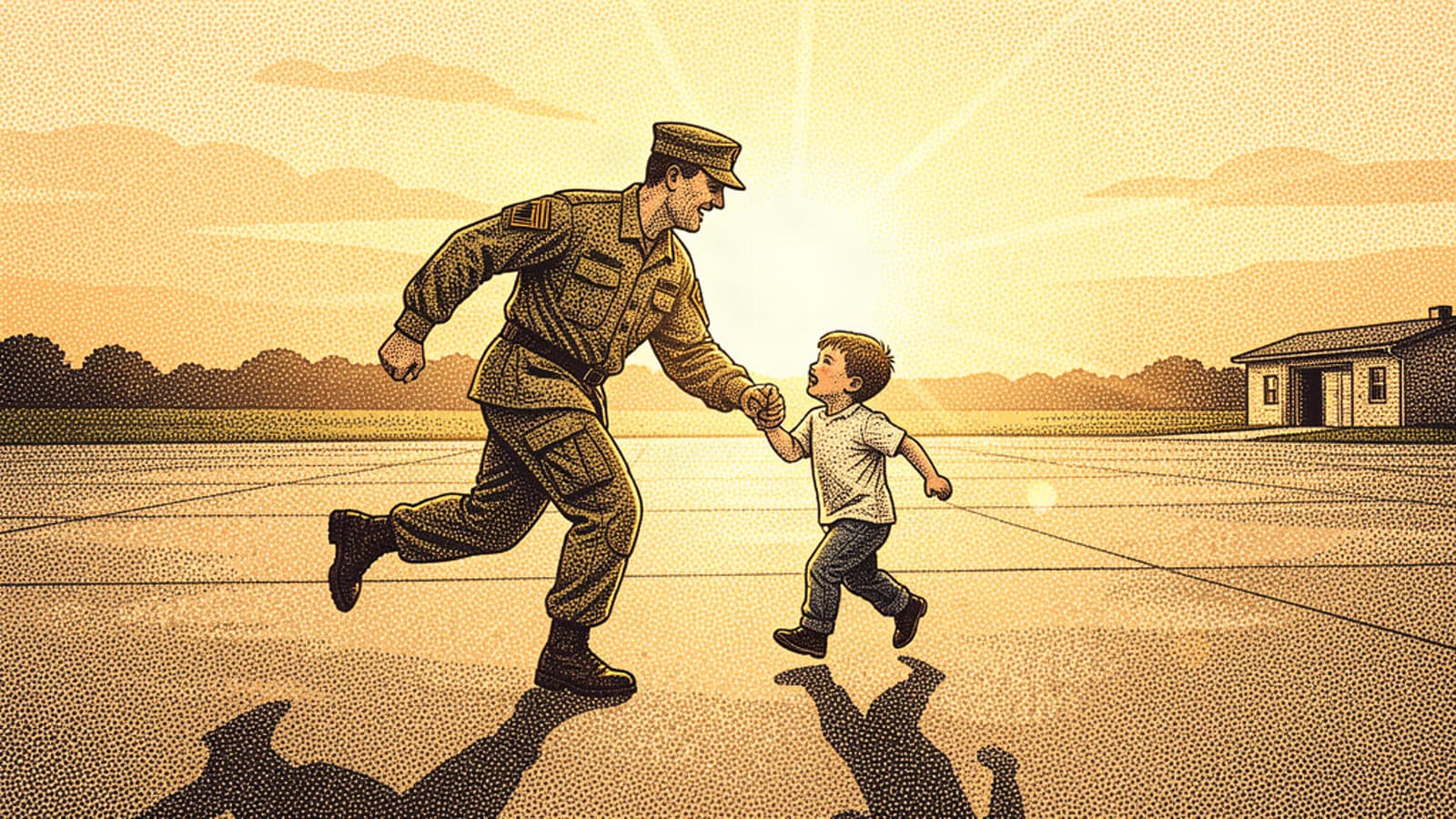
Then it happens. Someone yells, someone points, and suddenly everyone is moving. This is the part I never pose and never interrupt. I position myself early, anticipate the line of sight, and let the moment land on its own. A child running flat-out across a tarmac, arms wide. A teenager trying hard to be cool and losing it anyway. A spouse whose knees genuinely buckle. These happen in about four seconds, and they're the whole reason you hired me. Four seconds. That's all it takes. My job is to already be in the right place, lens up, before they begin.
After the Hug
Some families want me to follow them home for the quieter part — the service member seeing the new house, meeting the dog, walking through a front door that's been missing them. This is where homecoming photography becomes something closer to a family documentary. It's slower and softer, and often these are the images that end up framed on the wall, because they're about settling back in rather than the initial rush. The first meal at the same table. The kid showing off the growth chart on the pantry door. The dog losing its entire mind. These are the details that say we made it back to normal.
What to Wear and How to Prep the Kids
Let me keep this simple, because the last thing you need before a homecoming is an outfit crisis.
Wear something you feel like yourself in. This is not the session to break in new shoes or squeeze into something stiff. Think comfortable, put-together, and true to your family. If you want to lean in, a little red, white, and blue reads beautifully in these photos without feeling costume-y — a denim jacket, a soft chambray shirt, a child's flag-print dress. But honestly, what matters most is that when you hug, nothing pinches and you're not spending the moment adjusting a strap. This is a day about connection, not perfection.
For the kids, prep is mostly emotional. Tell them what's happening in words they can hold onto — the plane lands today, and we get to go meet him. Let them make a sign if they want. Pack a snack and a water bottle, because homecomings involve a lot of waiting. And if your little one melts down from the overwhelm, that's okay. Some of the most honest photos I've ever taken at a homecoming include a toddler who needed thirty extra seconds before the hug. I'll wait for the real moment, not the performed one.
After the Reunion, What You'll Have
Within a couple of weeks, you'll get a gallery of images that tell the whole arc of the day — the waiting, the running, the hugging, the quiet drive home. My advice is the same advice I give every family: don't let these live only on a screen. A homecoming photo is one of the rare images that carries real weight. It's the picture that goes in a frame on the mantel, that gets printed for a parent's desk, that a child looks at years later to remember what it felt like when their whole world came home. Print these. Hang them where you'll actually see them every day.
If the timing works, a homecoming session can also be the perfect bookend to a farewell session. A lot of the families I photograph at departure come back to me for the return, and there's something quietly powerful about having both — the goodbye and the hello, in the same style, telling the same family's story across the length of a deployment. The goodbye reminds you where you were. The hello reminds you it was worth the wait.