The Age Nobody Plans For
There's a folder on your phone that probably looks like this. Hundreds of photos from the newborn days, because everything was new and you were home and you couldn't stop taking them. A pile from the first birthday, most of them taken by a relative with the flash on. A few from the toddler years, usually at the pool or on a playground, always from far away. And then, somewhere around age five or six, the pictures start to thin out.
By ten, you're lucky if you have one good photo of your kid from an entire year.
I notice this more than most people do, because it's the thing parents say to me at the end of a session. Not the families with babies — they usually book early, having heard about newborn photos from a friend. It's the parents of school-age kids who say it. The ones who stopped scheduling anything because they thought the baby stage was the important part, and by the time they thought about it again, their kid was nine and had opinions about being photographed.
This is my argument for booking a school-age milestone session. Not the newborn session, which most parents already know about. The one in the middle, the one almost nobody does, and the one I think quietly matters most.
Why the School Photo Doesn't Cover This
I'm not going to talk you out of the fall school portrait. You'll buy it. Most families do, and I understand why — it's inexpensive and a chunk of it goes to the school.
But look at what the school photo actually records. A kid in a chair. A mottled grey-blue backdrop. A neutral expression, usually because the photographer has two hundred more children to get through before lunch. The same lighting as every child in the county. It tells you what your kid looked like in a particular week of a particular grade.
It doesn't tell you how they were doing. Not whether that was the fall they were brave about something. Not the sneakers they begged for and never took off. Not the laugh they had before it changed.
That's a gap worth filling once in a while. Not every year — I'm not making a case for an annual commitment to a photographer, and most families don't need one. But every couple of years, at a point where something has clearly shifted, a real session gives you the record the school photo can't.
What Changes Between Five and Twelve
Parents know their kid is growing. What's harder to see is how fast the face changes in that stretch. The CDC's child development overview lays out the milestones for these years in plain language, and it's a good reminder that a lot of what changes is happening quietly under the surface long before you notice it.
The Face Stops Being Round
Young faces are built to be young faces. Round cheeks, a soft jaw, eyes that take up a bigger share of the whole. It's charming and it's temporary. Somewhere between six and ten the roundness fades. The jaw sharpens. The nose gets more specific. Freckles show up after a summer and stay. The eyebrows arrive.
Then comes the last stretch before middle school, and the face changes again. Parents often tell me the two images look like different children — one at six and one at nine — in a way they never noticed in real life, because they were watching it happen one Tuesday at a time.
The Body Changes Even More
Kids in this range grow in fits. A burst of height one spring. A slow summer where nothing seems to happen. Shoes that don't fit by October. Their proportions shift too, the way they stand, the way they walk into a room.
Photographs are a funny record of this because they're flat and still. You don't watch a growth spurt happen in real life, but you'll look at a photo of your nine-year-old and think, they were that small? A session every year or two builds a set of reference points. Two images side by side tell a story no single picture can.
The Personality Gets Specific
This is the part I love most. Photograph a five-year-old and you get a kid who's curious, a little shy, and very interested in whatever is on the ground. Photograph an eleven-year-old and you get a person with a real sense of humor, a thing they're into, and a firm opinion about which side of their face is the good side.
That opinion is usable. It's a starting point, not an obstacle. If your kid has decided they only like photos from the left, we shoot the left. If they've made a playlist in the car, I'll ask about it on the walk out. By this age most kids will hand over a genuine expression if they feel like the choice about how they look is being respected, rather than managed the way they're managed at school picture day.
A Session That Doesn't Look Like a Session
Older kids are often the easiest and the hardest subjects I photograph. Easy, because they can take a direction and hold a conversation. Hard, because they have taste, and they can tell when they're being managed. So the best sessions with this age group usually don't look like sessions. They look like an afternoon.
Bring the Thing They Love
A soccer ball. An instrument. A skateboard. A dog. Whatever your kid is about right now, we can find a photo in it. That photo tends to age best, because years later it's a document of a specific passion at a specific age, not just generic childhood.
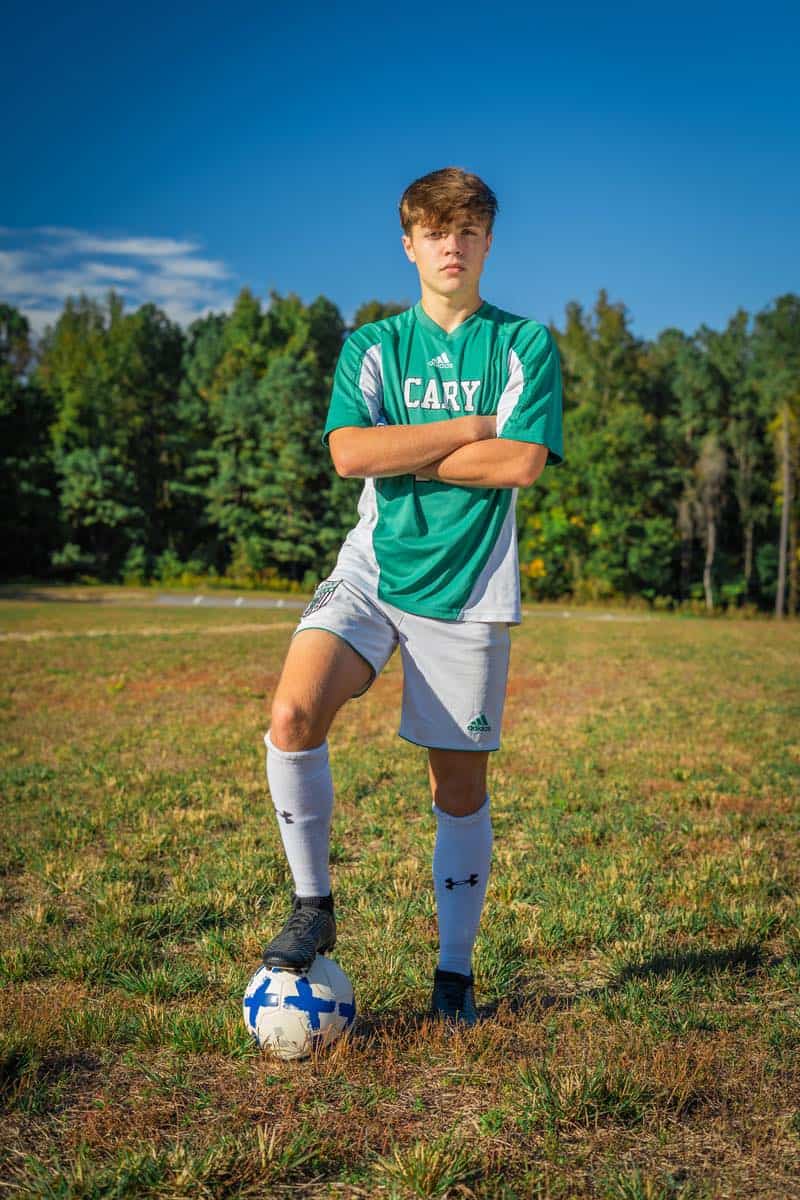
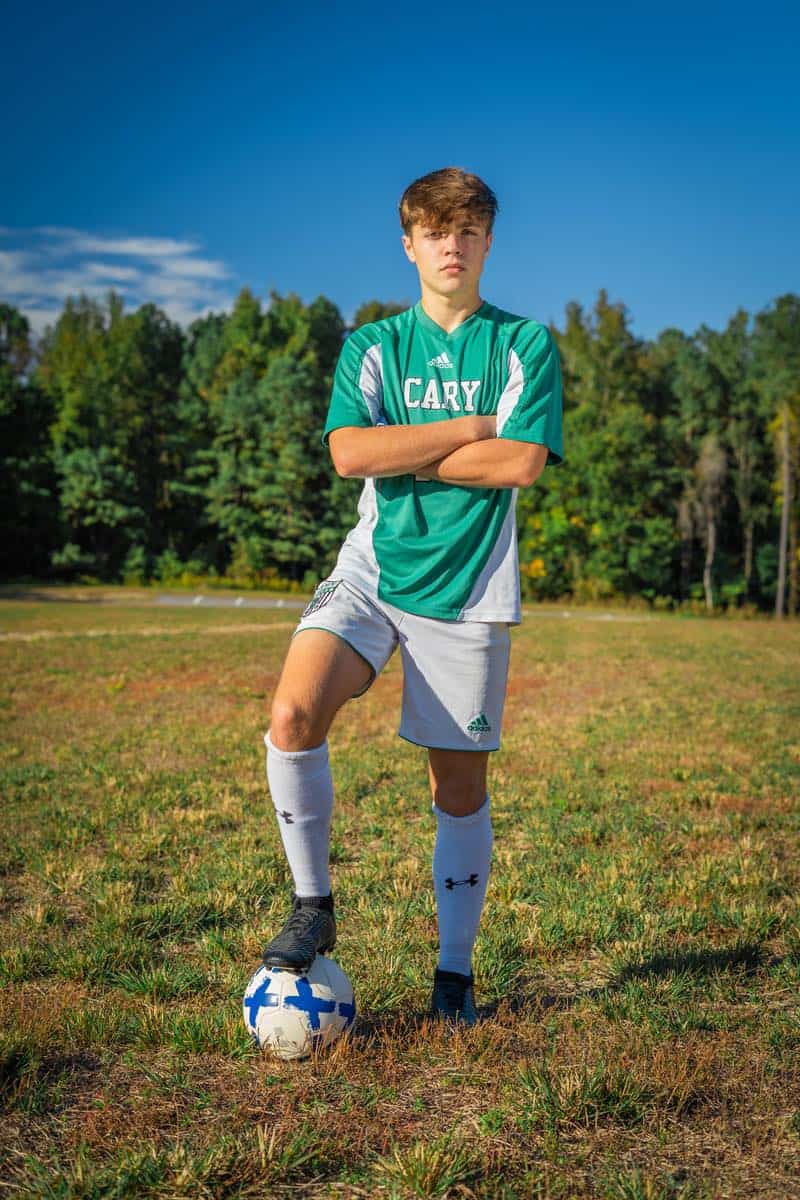
The foot-on-the-ball pose. He set that up himself. That's the whole session in one frame.
A uniform on a field. A clarinet held against a pond. A kid on a footbridge with both arms out like an airplane. These aren't stiff portraits, and that's exactly what makes them worth keeping.
Follow, Don't Pose
My favorite frames from a session with a nine-year-old are rarely the ones where I asked someone to sit and smile. They're the walk down the trail where they forgot I was behind them. The laugh right after someone slips in the mud. The moment they start talking about a best friend and their face does something I could never have asked for.
With an older kid, I can be more of a participant. We talk. I ask what they're reading. I ask about the season their team is having. They figure out in about five minutes whether I'm the kind of grown-up who's going to make them do something weird, and once that's settled we're fine.
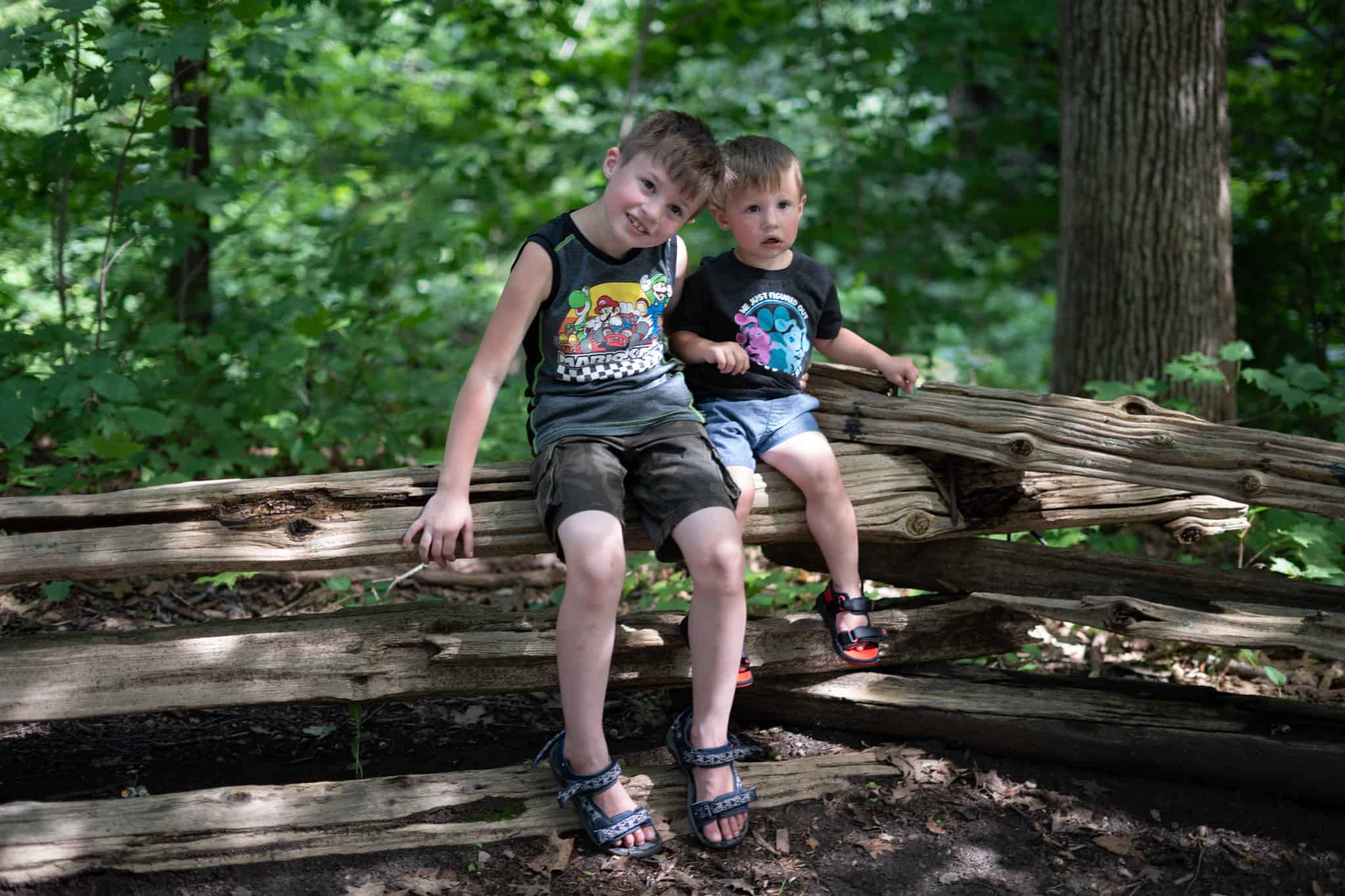
Brothers on a log fence. Nobody was posed into this. I just stood where the light was good and waited.
Let the Location Do the Work
Most of these sessions happen outdoors. A park with a path and some trees. A field at golden hour. A pine grove with shade and light bouncing around under the canopy. The setting gives a kid something to do and somewhere to look, and it gives the photos texture a plain background can't.
I've written about where these sessions happen around Spring Lake and Fort Bragg if you want to see the options before you pick one. I schedule older-kid sessions for late afternoon when I can. The light is softer, and kids this age tend to be at their best once the school day has wound down and they've had a snack. If your kid is a morning person, that works too. We adapt to what actually gets you a good expression.
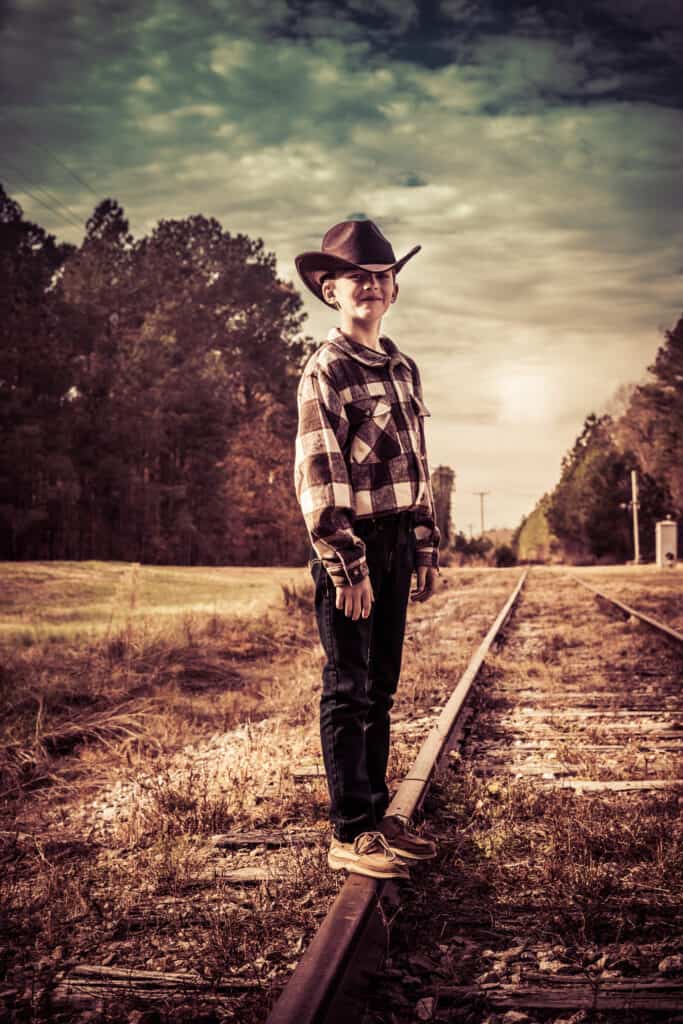
Balancing on a rail, in a hat he chose. Ten minutes of following him was worth more than an hour of posing.
The Awkward Age Is Not Really an Age
If you have a kid somewhere between eight and thirteen who has started to hide from the camera, I want you to know that's normal, and it isn't permanent.
This is the age when kids become aware they're being looked at. They've seen their own face on a phone screen, they've started comparing themselves to friends, and they've decided any photo taken of them will be terrible. Every single one. No matter what.
Some of that is real self-consciousness and some of it is just being ten. Either way, it doesn't get better if you stop taking their photo.
What helps is giving them some control. Let them pick the shirt. Let them pick the spot, within reason. Show them the back of the camera if they want to see, and put it away if they'd rather not. Ask what their favorite photo of themselves looks like, then go make that photo. Whenever a kid feels like a collaborator instead of a subject, the shoulders come down.
And if they're still not into it, wait a year. Nobody regrets the photos they took. A session that happens when they're ready is worth more than one that happens on your schedule.
What to Bring, What to Wear
Short list. The American Academy of Pediatrics grade-school pages are a useful read alongside this, mostly for remembering what a normal school-age kid is actually like on a given afternoon.
Clothes that fit. This is the thing parents get wrong most often in this age bracket. Not the color, not the style — the fit. A shirt a size too small because it was the only one clean, or pants two inches too long because they'll grow into them, both show in the photos. Bring a couple of options and pick the one that fits that day.
Colors that are theirs. With older kids, I'd rather photograph something they actually asked to wear than something coordinated to match a sibling. Navy, olive, mustard, denim, cream, a soft blue. Skip big graphics unless the graphic is a big part of who they are right now — and if it is, that's the photo.
A change of clothes. Because someone's going to sit on something damp. It happens at nearly every outdoor session.
The thing they're into. The ball, the instrument, the dog, the book, the sketchbook, the collection of rocks. Sometimes it works and sometimes it doesn't — I've had kids bring their whole collection of something and then not want a single photo with it. Still worth bringing. If your kid has a sport or a hobby that's eating their life right now, a portrait with the gear in it is one you'll love in ten years.
Snacks. Always. Even for a twelve-year-old. Especially for a twelve-year-old.
If you want more on clothes, my guide to what to wear to a photoshoot covers every age, and coordinating outfits for a family session is the one to read if siblings are in the frame.
Where the Milestone Session Fits
A milestone session with me is $200. It's the session I recommend for school-age kids — a portrait session built around the markers that matter at this age. Losing a tooth. Starting kindergarten. A growth spurt. A passion that appeared out of nowhere and took over the whole household. No props required, no elaborate setup.
A milestone session is the general version of this, and the children's milestone photography guide follows the years from toddler through school age. If your child is still a baby, the first year milestone timeline lays out the newborn, sitter, and first birthday arc, and the cake smash session is the frosting-and-mess version of that first birthday.
If your kid is heading back to school and you want the whole year documented, the year in review family session is a different way to think about it. Family sessions are the other option, and they're $400. If you want the whole group in the frame with a bigger emphasis on everyone together, what to expect at a family photo session is the post to read. If you want your kid to have their own set of images that are about them and not about the group, the milestone session is the better call.
Everything happens on location or in your home. There's no studio to drive to, and your kid is in a place that already feels like theirs. Travel is included within thirty miles of Spring Lake, which covers Fayetteville, Fort Bragg, and Sanford. If you're near the base or in one of the surrounding towns, we can usually find a spot that works.
Booking One
School-age sessions fit best in fall and early spring, but any decent month works. Late afternoon on a Saturday, or a weekday right after school before the light goes. An hour is usually plenty, and with an easygoing kid it's often less.
If you're not sure whether a milestone or a mini session is the better fit for a busy school year, what a mini session is breaks down the shorter option. Send me a message with your kid's age and what they're into right now. I don't need more than that to start planning. And if this happens to be the year yours is finally willing to be photographed, that's worth using.
They'll be a year older next year, and so will you. The photo happens now, or it happens later, and later has a way of arriving before you've scheduled it.
§ Ready when you are
Let's get you on the calendar
Pick a session and a date, pay your retainer online, and it's booked. Sessions from $99.