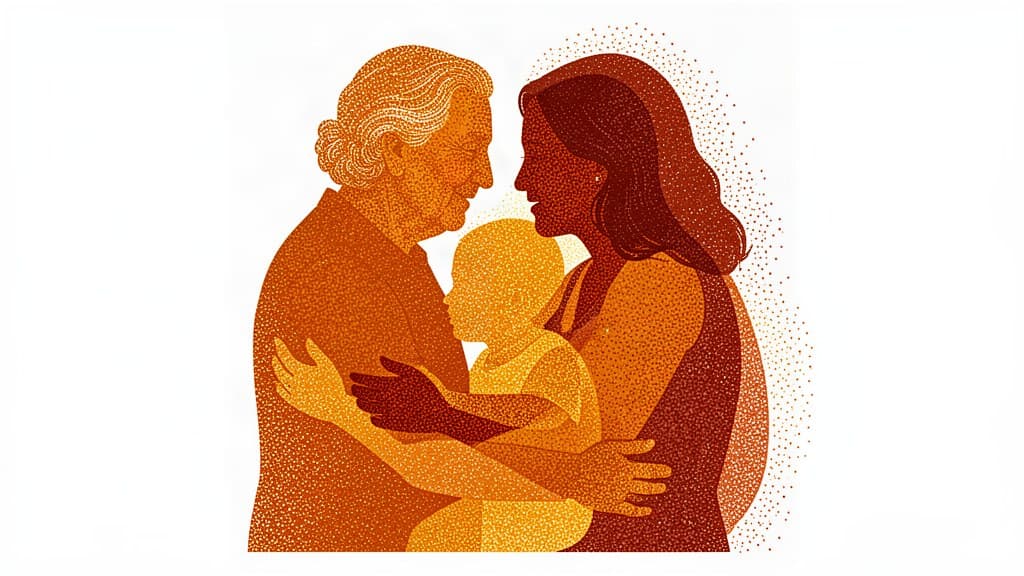
There's a photograph I keep coming back to from a few summers ago. Four generations of one family — a great-grandmother in her nineties, her daughter, her granddaughter, and a six-month-old great-grandson — sitting together on a porch swing in Spring Lake. The outfits weren't perfectly coordinated. The baby was mid-yawn. The great-grandmother had taken her hearing aids out. And none of it mattered, because when I look at that image I don't see any of those things. I see four faces that are clearly the same face, reshaped by ninety years, all tilted toward the camera at the exact same angle. That photograph is the whole reason extended family sessions exist. Not to chase a perfect pose. To catch a family's features moving through the generations while everyone is still here to stand in the same frame.
I've photographed families around Fort Liberty and Spring Lake for years, and here's the pattern I've noticed: the big, multi-generational sessions are the ones people hesitate over the longest and treasure the most. This post is everything I've learned about making them actually happen — the scheduling, the outfits, the beautiful chaos, and the reason you shouldn't keep waiting.
Why Extended Family Photos Are Different
A portrait of your immediate family is a snapshot of the season you're in right now. An extended family photo is about the whole arc — grandparents, parents, grandkids, sometimes great-grandparents, all in one frame. That single difference changes everything about how the session feels.
For one thing, the stakes feel higher. These are the images that end up on more walls than anything else you'll ever commission. They get framed for Grandma's hallway, printed for the cousins, emailed to relatives overseas, tucked into the back of an album that outlives the person who put it there. For another thing, the cast is bigger — which means more personalities, more nap schedules, more opinions about wardrobe, and at least one person who is absolutely convinced they don't photograph well.
That last one is almost always a grandpa. And it's almost never true. But I'll get back to him.
I remember one session where a grandmother flew in from Ohio specifically for this. Her daughter had told her, "Mom, we're finally doing the big family photo, and you're going to be in it." She hadn't been in a professional photograph in thirty years — she'd spent three decades as the one taking the pictures, documenting everyone else's lives while quietly staying out of the frame herself. When she saw her gallery, she went quiet for a long moment. Then she said, "I didn't know I looked like that." She meant it as a compliment, but what she was really seeing was herself the way her family sees her. That quiet recognition is the hidden gift of these sessions, and it happens more often than you'd think.
The Hardest Part Is the Calendar
If I could hand you one honest truth about extended family sessions, it's this: the photograph is the easy part. Getting eight or twelve or twenty people to agree on a date is the actual challenge. I've watched families spend more energy coordinating a single session than they did planning an entire reunion.
Pick a Date Like a General, Not a Committee
Here's what works. One person — usually the mom who is already wrangling everyone anyway — picks two or three dates and sends them out. Not an open group thread asking, "What works for everyone?" That thread never ends. It turns into a referendum on every kid's soccer schedule and then goes quiet at the exact moment you need a decision.
Send two or three concrete options. Ask people to flag what absolutely won't work. Then choose. When the goal is actually getting the photograph taken, decisive beats democratic every single time.
What to Do When Someone Can't Be There
This is the part nobody wants to say out loud, so let me say it plainly: there is no guarantee that every person will be available, and the worst thing you can do is cancel the whole session because one schedule didn't line up. I've had families wait two full years for a date where every single person could make it, only to have it fall apart anyway. Shoot with whoever can come. We can honor the missing person — a framed photo held in the group shot, a FaceTime call set up mid-session so they can watch it happen. Waiting for perfect availability usually just means waiting forever.
What to Wear (Without Dressing Alike)
The short version: coordinate, don't match. The long version is its own guide — I've written a whole post on what to wear to a photoshoot — but the extended-family edition has a few extra rules, because now the palette has to work across three generations instead of four people.
Pick two to four colors and let everyone interpret them their own way. Grandma gets to wear the cream cardigan she loves. Your sister-in-law does a soft blue dress. The kids wear whatever combination of those tones still fits them this week. The goal is that nobody clashes and nobody looks like they were issued matching khakis by committee.
And gently — give the grandparents a little guidance. They'll often ask, and one clear sentence saves everyone: "We're doing soft neutrals and warm tones, nothing too bright or busy." That's usually all it takes to prevent a surprise neon polo from walking into the frame.
How the Session Actually Unfolds
If you've never done one, here's the shape of it. An extended family session is a touch more structured than a regular family session, for one simple reason: there are a lot of people, and a lot of combinations you'll want to walk away with.
The Big Group Shot First
I always start with everyone together, while the kids are fresh and before anyone's shirt comes untucked or anyone gets hangry. We get the hero image — the one that's going on everyone's wall — right at the top, when the energy is highest and the light is still doing exactly what I want it to. Get that one in the bag and everything else is gravy.
Then the Smaller Groupings
After the big shot, we work through the combinations that matter. Grandparents with all the grandkids. Each individual family unit on its own. The adult siblings together — a shot so many people forget they want until they see it. Maybe just the cousins, or grandma with her daughters, or a single grandchild with a great-grandparent. This is where I get to be a little more documentary and a little less posed, and it's honestly where some of my favorite images come from. Two people who've known each other for seventy years, laughing at a private joke, look nothing like two people posing politely for a camera.
I keep the whole thing moving so nobody runs out of patience — especially the toddlers, who have a hard limit on how long they'll tolerate being in one place. Big group, small groups, done. Usually within an hour or so, even for the bigger families.
Why This Matters for Military Families
If you're a military family at Fort Liberty, you already know the truth that makes these sessions urgent: everyone being in the same state on the same day is not something you can take for granted. Deployments, PCS moves, leave windows — the stretch of time where Grandma can fly in and your spouse is home and the cousins are in town is often heartbreakingly small.
That's why extended family sessions here tend to cluster around specific moments: a homecoming, a holiday visit, a send-off, a first birthday where the grandparents made the trip. If the whole family is together, that's the photo. Don't let it pass because nobody thought to book it. I've watched too many families realize this the day after everyone flew back home.
Don't Wait for a 'Perfect' Occasion
Here's my last thought, and it's the one I hope you keep. Families spend a lot of time waiting for the right moment to take a big family photo — the reunion next summer, the big anniversary, the time when everyone looks their best and the weather cooperates. But there is no perfect occasion, and there is no perfect version of your family waiting down the road. The family you have right now — the great-grandmother who's still sharp, the grandpa who tells the same stories, the toddler who will not hold still — that is the family worth photographing. Right now.
Remember the grandpa who swears he doesn't photograph well? Put him next to his grandchildren and watch his whole face change. And the mom who's always the one behind the camera — this is the session where you finally get to be in the picture, standing beside the people you've spent years photographing everyone else with. If your whole family is about to be in the same zip code, let's make the most of it while they are. I'd be honored to help you plan it.